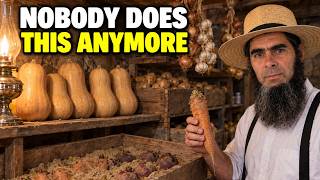
How We Store ONE YEAR'S Worth of Homegrown Food
リアクション
2026年09月18日
🔗 Save $6,000 A Year with My Complete Amish Home-Saving Method I teach:
https://eliasyoder.com
You grew it all. The potatoes came up heavy, the squash ran all over the garden, the carrots were the best you have had, and you carried the whole lot down in October feeling like a rich man.
Then February came. Sprouts as long as your finger. Carrots gone limp and bendy. Half the onions soft at the neck and the other half growing. A squash at the back collapsed into itself, and the smell got into everything.
That was not bad luck and it was not the growing.
Every book tells you to put storage crops in a cool dark place. That is not wrong exactly. It is just so far short of the truth that following it will cost you half your harvest. Because a cellar is not one place. The floor along the north wall is cold and damp enough that the stone sweats. The top shelf by the stairs is dry as a bone. Your carrots want one and your onions want the other.
We have no machine anywhere in our food storage. No cold box, no freezer, no fan. A stone cellar, a sand box, some slatted shelves, and a good deal of knowing where to put a thing.
My grandfather settled it for me when I was twelve. He let me put the harvest away alone and I set it all out in tidy rows on the same three shelves. By February the potatoes had sprouted, the onions were soft and the carrots were rubber. He took me down with the lamp, told me to put one hand flat on the cold stone floor and the other on the top shelf by the stair door, and asked me which of those was the cellar.
What we go through:
The four corners of any cellar, and which crop belongs in each one Curing, and why three crops want three completely different cures The sweet potato mistake almost everybody makes, and why yours went hard and tasteless in December Why light on a potato is a safety matter and not just a looks matter Cutting tops off roots, and packing carrots and beets in damp sand so they come out crisp in April Why onions and potatoes must never sit near each other Snapping the soft ends off sweet potatoes before they go in The pillowcase method for threshing beans, and winnowing in a doorway on a breezy day Why a sealed bag or tub turns a crop slimy, and what to store in instead Getting a cellar to breathe with two screened vents and no power at all Eating in the right order, so nothing goes by unnoticed Keeping mice out by keeping them out, rather than putting poison beside your food
What none of this fixes: if you have no cellar, a north-facing closet on an outside wall, an unheated landing, a bulkhead, or an old barrel buried on its side with straw over it will all work, and that last one is what families used before there were cellars at all. And some things were never storage crops. Sweet corn, tomatoes, peppers, summer squash and greens get eaten, dried or put in jars, and that is a different job.
There is no scheme in any of this. The money simply runs the other way. Nobody makes a living telling you a wooden box of damp sand on a cold floor will keep carrots better than a machine will.
This week, buy two plain dial thermometers, the kind that need no power. Put one on the floor against your coldest outside wall and the other on the highest shelf at the warm end of the same room. Leave them a day, then read them both.
Tell me in the comments what county you are in and how deep your ground freezes. And come back and tell me those two numbers. I have a notion some of you will be surprised by the spread.
Next time we go back to the beginning of the whole business, because the finest way to have food next winter costs nothing and it is sitting inside the very things you have just put away. Saving your own seed, properly.
I gathered the whole of it into a book at eliasyoder dot com.
The people who built this country with their hands knew that, and we are only just starting to remember it.
#EliasYoder #RootCellar #FoodStorage #Homesteading #Harvest #StorageCrops #SelfReliance #Gardening #GrowYourOwnFood #OldWays #Preserving #WinterSquash #Potatoes #NoFridge #Prepping
https://eliasyoder.com
You grew it all. The potatoes came up heavy, the squash ran all over the garden, the carrots were the best you have had, and you carried the whole lot down in October feeling like a rich man.
Then February came. Sprouts as long as your finger. Carrots gone limp and bendy. Half the onions soft at the neck and the other half growing. A squash at the back collapsed into itself, and the smell got into everything.
That was not bad luck and it was not the growing.
Every book tells you to put storage crops in a cool dark place. That is not wrong exactly. It is just so far short of the truth that following it will cost you half your harvest. Because a cellar is not one place. The floor along the north wall is cold and damp enough that the stone sweats. The top shelf by the stairs is dry as a bone. Your carrots want one and your onions want the other.
We have no machine anywhere in our food storage. No cold box, no freezer, no fan. A stone cellar, a sand box, some slatted shelves, and a good deal of knowing where to put a thing.
My grandfather settled it for me when I was twelve. He let me put the harvest away alone and I set it all out in tidy rows on the same three shelves. By February the potatoes had sprouted, the onions were soft and the carrots were rubber. He took me down with the lamp, told me to put one hand flat on the cold stone floor and the other on the top shelf by the stair door, and asked me which of those was the cellar.
What we go through:
The four corners of any cellar, and which crop belongs in each one Curing, and why three crops want three completely different cures The sweet potato mistake almost everybody makes, and why yours went hard and tasteless in December Why light on a potato is a safety matter and not just a looks matter Cutting tops off roots, and packing carrots and beets in damp sand so they come out crisp in April Why onions and potatoes must never sit near each other Snapping the soft ends off sweet potatoes before they go in The pillowcase method for threshing beans, and winnowing in a doorway on a breezy day Why a sealed bag or tub turns a crop slimy, and what to store in instead Getting a cellar to breathe with two screened vents and no power at all Eating in the right order, so nothing goes by unnoticed Keeping mice out by keeping them out, rather than putting poison beside your food
What none of this fixes: if you have no cellar, a north-facing closet on an outside wall, an unheated landing, a bulkhead, or an old barrel buried on its side with straw over it will all work, and that last one is what families used before there were cellars at all. And some things were never storage crops. Sweet corn, tomatoes, peppers, summer squash and greens get eaten, dried or put in jars, and that is a different job.
There is no scheme in any of this. The money simply runs the other way. Nobody makes a living telling you a wooden box of damp sand on a cold floor will keep carrots better than a machine will.
This week, buy two plain dial thermometers, the kind that need no power. Put one on the floor against your coldest outside wall and the other on the highest shelf at the warm end of the same room. Leave them a day, then read them both.
Tell me in the comments what county you are in and how deep your ground freezes. And come back and tell me those two numbers. I have a notion some of you will be surprised by the spread.
Next time we go back to the beginning of the whole business, because the finest way to have food next winter costs nothing and it is sitting inside the very things you have just put away. Saving your own seed, properly.
I gathered the whole of it into a book at eliasyoder dot com.
The people who built this country with their hands knew that, and we are only just starting to remember it.
#EliasYoder #RootCellar #FoodStorage #Homesteading #Harvest #StorageCrops #SelfReliance #Gardening #GrowYourOwnFood #OldWays #Preserving #WinterSquash #Potatoes #NoFridge #Prepping