RL Environments Explained: How AI Agents Learn Real-World Work | Brendan Foody, Mercor
リアクション
2026年08月12日
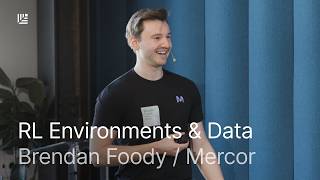
RL environments have become the hottest topic in AI training data. But what are they, exactly? At Sequoia Capital’s Own Your Intelligence event, Mercor CEO Brendan Foody breaks down the three components: worlds (the messages, docs, and files of a real project), apps (high-fidelity clones of tools like Salesforce and Google Workspace), and tasks (prompts paired with rubric-based verifiers). He walks through a real legal environment built with lawyers from top firms, and shares post-training results showing dramatic gains on domain-specific tasks from modest compute.
Brendan also covers why humans remain essential for measuring the frontier, how Mercor prices data, the shift from crowdsourced labeling to expert-built environments, and what's next: ultra-long-horizon tasks and virtual coworkers. He argues that technology once limited to frontier labs is now reaching application companies, and the datasets they build are becoming their moat.
00:00 Introduction
00:47 A short history of the data market: crowdsourcing to agentic data
02:29 What an RL environment is: worlds, apps, tasks
03:57 Why only humans can measure the frontier
05:35 Building verifiers is the hard part
06:44 Walkthrough: a real legal RL environment
08:18 Leaderboards — and what open weights change
09:45 Post-training results on Apex Agents
11:17 Three ways companies buy data
12:49 Q&A: How do you price data?
14:17 Q&A: What "data quality" actually means
16:42 Q&A: The misunderstanding about synthetic data
18:17 Q&A: Why RL environments now — and what comes after
21:20 Q&A: Can you scale rubric generation with models?
23:00 Q&A: RL environments for cyber defense
25:33 Q&A: Build data in-house or partner?
Brendan also covers why humans remain essential for measuring the frontier, how Mercor prices data, the shift from crowdsourced labeling to expert-built environments, and what's next: ultra-long-horizon tasks and virtual coworkers. He argues that technology once limited to frontier labs is now reaching application companies, and the datasets they build are becoming their moat.
00:00 Introduction
00:47 A short history of the data market: crowdsourcing to agentic data
02:29 What an RL environment is: worlds, apps, tasks
03:57 Why only humans can measure the frontier
05:35 Building verifiers is the hard part
06:44 Walkthrough: a real legal RL environment
08:18 Leaderboards — and what open weights change
09:45 Post-training results on Apex Agents
11:17 Three ways companies buy data
12:49 Q&A: How do you price data?
14:17 Q&A: What "data quality" actually means
16:42 Q&A: The misunderstanding about synthetic data
18:17 Q&A: Why RL environments now — and what comes after
21:20 Q&A: Can you scale rubric generation with models?
23:00 Q&A: RL environments for cyber defense
25:33 Q&A: Build data in-house or partner?