The HSP Paradox: Why your sensitivity is actually a biological superpower.
リアクション
2026年03月16日
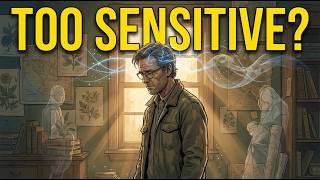
At some point, someone told you that you were too sensitive. Too emotional. Too affected by things others brush off. And at some point, you started to believe them. What nobody told you — and what a growing body of scientific research has been documenting for decades — is that what you were told was a weakness is one of the most sophisticated neurological adaptations in the entire human species. This video explores the science of Sensory Processing Sensitivity: what Dr. Elaine Aron discovered in 1996, what brain imaging research by Jadzia Jagiellowicz revealed about how HSP brains process information, and what Jay Belsky's differential susceptibility hypothesis says about why sensitive people aren't the most fragile people in the room — they're the most responsive.
The HSP brain doesn't process more emotional data because something went wrong. It activates more strongly in the insula and prefrontal cortex — the regions associated with empathy, creative insight, moral reasoning, and social intelligence — because it is structurally built for depth, not speed. The same mechanism that makes a loud office overwhelming is what makes you capable of hearing what others miss in a conversation, sensing what's wrong before it becomes visible, and producing work with layers of precision that standard processing simply cannot access. You were never too much. Your brain was always doing more.
This video also explores the HSP self-doubt spiral, the vantage sensitivity effect discovered by Michael Pluess at Queen Mary University of London — which shows that highly sensitive people don't just respond more to negative experiences, they respond more to positive interventions — and what the research consistently shows about what becomes possible when a highly sensitive person stops spending their energy managing their sensitivity and starts understanding what it's actually for.
Not behind. Just deep-rooted.
The HSP brain doesn't process more emotional data because something went wrong. It activates more strongly in the insula and prefrontal cortex — the regions associated with empathy, creative insight, moral reasoning, and social intelligence — because it is structurally built for depth, not speed. The same mechanism that makes a loud office overwhelming is what makes you capable of hearing what others miss in a conversation, sensing what's wrong before it becomes visible, and producing work with layers of precision that standard processing simply cannot access. You were never too much. Your brain was always doing more.
This video also explores the HSP self-doubt spiral, the vantage sensitivity effect discovered by Michael Pluess at Queen Mary University of London — which shows that highly sensitive people don't just respond more to negative experiences, they respond more to positive interventions — and what the research consistently shows about what becomes possible when a highly sensitive person stops spending their energy managing their sensitivity and starts understanding what it's actually for.
Not behind. Just deep-rooted.