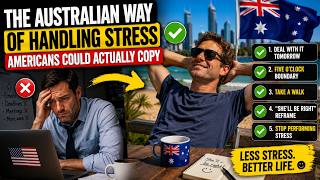
"The Australian Way of Handling Stress Americans Could Actually Copy"
リアクション
2026年09月03日
It is September 2026, and if you take a cross-section of modern American society, you will find a population running on high-test caffeine, relentless performance metrics, and a low-grade, perpetual state of burnout. In the U.S., stress is treated almost as a badge of honor—a visible proof of hustle, ambition, and economic survival.
When you drop into the rhythm of daily life in Australia, however, you encounter a society facing the exact same global economic pressures, inflation, and work demands, yet approaching psychological stress from an entirely different cultural operating system.
Instead of glorifying exhaustion, Australians have mastered a pragmatic, psychologically grounded set of stress-handling habits that stressed-out Americans could copy right now.
🔍 The 4 Australian Stress-Busters Americans Desperately Need
1. The Culturally Mandated "Have a Cuppa" Pause:
The American Habit: When an American is overwhelmed, the knee-jerk reaction is to double down, skip lunch, stare harder at the screen, and mainline another iced coffee while answering emails.
The Aussie Habit: No matter how frantic a workplace gets, Australian culture insists on a mandatory physical break for tea or coffee. Dropping everything at 10:30 AM to walk away from the desk, chat with colleagues about non-work topics over a flat white, and completely disconnect for 15 minutes is treated as a non-negotiable mental reset button rather than a waste of time.
2. The Sacred "Do Not Disturb" Boundary (Switched-Off Annual Leave):
The American Habit: American workers take pride in checking Slack on vacation, bringing laptops to beach resorts, and treating PTO (paid time off) as a fragile suggestion rather than a legal right.
The Aussie Habit: Australians view the legally mandated minimum of four weeks of annual leave (plus public holidays) as sacred. When an Aussie goes "on leave," their out-of-office auto-responder is a hard brick wall. Checking work email from a Bali resort or a coastal camping trip is viewed not as dedication, but as socially embarrassing and genuinely unhinged behavior.
3. Weekend Compartmentalization ("Go Bush" or "Hit the Surf"):
The American Habit: Americans often spend their weekends doing chores, running errands, or stressing about the upcoming Monday morning backlog, letting work bleed into every waking hour.
The Aussie Habit: The moment Friday afternoon hits, the national psychological switch flips. Australians fiercely protect their weekends for physical decompression—heading to the beach, hiking national parks, or gathering for a casual backyard BBQ. Nature isn't a luxury vacation reserved for once a year; it is an active, weekly therapeutic prescription to clear the head.
4. Linguistic De-Escalation ("She’ll Be Right" and "No Worries"):
The American Habit: American communication culture is high-stakes, urgent, and dramatic, often treating minor logistical delays as full-scale corporate emergencies.
The Aussie Habit: The ubiquitous phrases "No worries, mate" and "She’ll be right" are not just slang; they are linguistic de-escalation tools. By actively minimizing catastrophizing and verbally framing everyday hiccups as manageable, Australians chemically lower the collective social temperature of any room.
Disclaimer:
This video is created for informational and entertainment purposes only. The content presented reflects research, analysis, and opinions based on publicly available information and does not claim to represent official statements or positions of any government or organization. Viewers are encouraged to conduct their own research and form independent opinions.
This video, including the script, visuals, and audio, has been created with the assistance of artificial intelligence (AI).
When you drop into the rhythm of daily life in Australia, however, you encounter a society facing the exact same global economic pressures, inflation, and work demands, yet approaching psychological stress from an entirely different cultural operating system.
Instead of glorifying exhaustion, Australians have mastered a pragmatic, psychologically grounded set of stress-handling habits that stressed-out Americans could copy right now.
🔍 The 4 Australian Stress-Busters Americans Desperately Need
1. The Culturally Mandated "Have a Cuppa" Pause:
The American Habit: When an American is overwhelmed, the knee-jerk reaction is to double down, skip lunch, stare harder at the screen, and mainline another iced coffee while answering emails.
The Aussie Habit: No matter how frantic a workplace gets, Australian culture insists on a mandatory physical break for tea or coffee. Dropping everything at 10:30 AM to walk away from the desk, chat with colleagues about non-work topics over a flat white, and completely disconnect for 15 minutes is treated as a non-negotiable mental reset button rather than a waste of time.
2. The Sacred "Do Not Disturb" Boundary (Switched-Off Annual Leave):
The American Habit: American workers take pride in checking Slack on vacation, bringing laptops to beach resorts, and treating PTO (paid time off) as a fragile suggestion rather than a legal right.
The Aussie Habit: Australians view the legally mandated minimum of four weeks of annual leave (plus public holidays) as sacred. When an Aussie goes "on leave," their out-of-office auto-responder is a hard brick wall. Checking work email from a Bali resort or a coastal camping trip is viewed not as dedication, but as socially embarrassing and genuinely unhinged behavior.
3. Weekend Compartmentalization ("Go Bush" or "Hit the Surf"):
The American Habit: Americans often spend their weekends doing chores, running errands, or stressing about the upcoming Monday morning backlog, letting work bleed into every waking hour.
The Aussie Habit: The moment Friday afternoon hits, the national psychological switch flips. Australians fiercely protect their weekends for physical decompression—heading to the beach, hiking national parks, or gathering for a casual backyard BBQ. Nature isn't a luxury vacation reserved for once a year; it is an active, weekly therapeutic prescription to clear the head.
4. Linguistic De-Escalation ("She’ll Be Right" and "No Worries"):
The American Habit: American communication culture is high-stakes, urgent, and dramatic, often treating minor logistical delays as full-scale corporate emergencies.
The Aussie Habit: The ubiquitous phrases "No worries, mate" and "She’ll be right" are not just slang; they are linguistic de-escalation tools. By actively minimizing catastrophizing and verbally framing everyday hiccups as manageable, Australians chemically lower the collective social temperature of any room.
Disclaimer:
This video is created for informational and entertainment purposes only. The content presented reflects research, analysis, and opinions based on publicly available information and does not claim to represent official statements or positions of any government or organization. Viewers are encouraged to conduct their own research and form independent opinions.
This video, including the script, visuals, and audio, has been created with the assistance of artificial intelligence (AI).