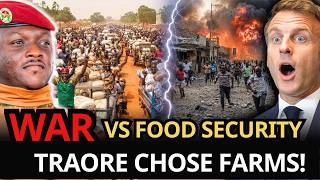
AFRICA Armed For WAR — Burkina Faso Poured $280 MILLION Into FOOD SECURITY
リアクション
2026年05月11日
Burkina Faso is taking a path that many nations in the Sahel are unwilling to attempt. While military spending continues to dominate headlines across the region, Captain IbrahimTraore is pushing a strategy that could completely reshape how Africa thinks about national security, economic independence, and long-term survival.
Across the Sahel, insecurity has forced governments to invest heavily in weapons, armored vehicles, and military operations. Armed violence has spread through rural communities, displacing families and destroying local economies. But Ibrahim Traore appears to believe that a nation cannot achieve true stability if its people remain trapped in hunger, unemployment, and dependence on imported food.
That belief is now driving one of the most ambitious agricultural transformations in modern Burkina Faso.
Under Traore’s leadership, the government has committed massive investments into agriculture, irrigation systems, food storage infrastructure, fertilizer subsidies, and improved seeds for local farmers. Instead of seeing farming as a weak or outdated sector, Burkina Faso is treating food production as a strategic pillar of national sovereignty.
For many supporters of Pan-African ideals, this approach represents something much larger than agriculture alone. It reflects a growing movement across the continent calling for self-reliance, economic resilience, and freedom from external dependence. In a world shaped by global supply chain disruptions, rising food prices, and geopolitical instability, food sovereignty is becoming one of the most important political issues of the modern era.
The war in Ukraine exposed how vulnerable many African countries remain when they rely heavily on imported grain and fertilizer. Rising transportation costs and instability across international markets created economic pressure for millions of families. Burkina Faso was not immune to these challenges.
Rather than waiting for foreign aid or outside solutions, Ibrahim Traore is attempting to strengthen domestic production from within. Large-scale investments in local agriculture aim to reduce dependence on external systems while rebuilding rural economies damaged by years of insecurity.
This strategy has attracted attention far beyond Burkina Faso. Across Africa and within the AfricanDiasporaNewsChannel community, many people see Traore as part of a new generation of African leadership focused on internal development instead of foreign dependency.
At the same time, critics remain skeptical. Some Western analysts argue that Burkina Faso should prioritize military operations above all else while insecurity continues. Others question whether such large agricultural subsidies can remain sustainable under current economic conditions.
But supporters of Traore reject the idea that security and agriculture should be separated. Hunger itself can become a source of instability. Poverty, food shortages, and unemployment can weaken a nation just as seriously as armed conflict.
That is why this conversation matters not only for Burkina Faso, but for the future of Africa new development strategies as a whole.
Traore’s policies also connect strongly with wider debates inside the African Union about sovereignty, regional resilience, and economic independence. Across the continent, many citizens are increasingly questioning whether old economic models tied too closely to foreign powers like France can truly deliver long-term stability.
In this vision of PanAfricanism, national strength is measured not only by military capability, but by the ability of a country to feed its own people, protect its farmers, and build sustainable internal growth.
Burkina Faso still faces enormous challenges. Armed groups remain active in several regions. Climate risks continue threatening agricultural production. Infrastructure limitations and economic pressures have not disappeared. Success is far from guaranteed.
Yet what makes this story so important is the larger idea behind it.
While much of the world focuses only on conflict and military headlines, Burkina Faso is also trying to build another line of defense — one based on farms, food reserves, local production, and national dignity.
Perhaps Captain IbrahimTraore understands something many leaders are only beginning to realize: weapons may defend borders, but agriculture protects the future of civilization itself.
AFRICA RISING VIEW continues bringing you deep analysis on leadership, sovereignty, economic transformation, and the changing future of the African continent. Share your thoughts below and join the conversation about the future of Africa.
#IbrahimTraore
#AfricanDiasporaNewsChannel
#BurkinaFaso
#BurkinaFasoPresident
#CaptainIbrahimTraore
#IbrahimTraoré
#PanAfricanism
#IbrahimTraoreBurkinaFaso
Across the Sahel, insecurity has forced governments to invest heavily in weapons, armored vehicles, and military operations. Armed violence has spread through rural communities, displacing families and destroying local economies. But Ibrahim Traore appears to believe that a nation cannot achieve true stability if its people remain trapped in hunger, unemployment, and dependence on imported food.
That belief is now driving one of the most ambitious agricultural transformations in modern Burkina Faso.
Under Traore’s leadership, the government has committed massive investments into agriculture, irrigation systems, food storage infrastructure, fertilizer subsidies, and improved seeds for local farmers. Instead of seeing farming as a weak or outdated sector, Burkina Faso is treating food production as a strategic pillar of national sovereignty.
For many supporters of Pan-African ideals, this approach represents something much larger than agriculture alone. It reflects a growing movement across the continent calling for self-reliance, economic resilience, and freedom from external dependence. In a world shaped by global supply chain disruptions, rising food prices, and geopolitical instability, food sovereignty is becoming one of the most important political issues of the modern era.
The war in Ukraine exposed how vulnerable many African countries remain when they rely heavily on imported grain and fertilizer. Rising transportation costs and instability across international markets created economic pressure for millions of families. Burkina Faso was not immune to these challenges.
Rather than waiting for foreign aid or outside solutions, Ibrahim Traore is attempting to strengthen domestic production from within. Large-scale investments in local agriculture aim to reduce dependence on external systems while rebuilding rural economies damaged by years of insecurity.
This strategy has attracted attention far beyond Burkina Faso. Across Africa and within the AfricanDiasporaNewsChannel community, many people see Traore as part of a new generation of African leadership focused on internal development instead of foreign dependency.
At the same time, critics remain skeptical. Some Western analysts argue that Burkina Faso should prioritize military operations above all else while insecurity continues. Others question whether such large agricultural subsidies can remain sustainable under current economic conditions.
But supporters of Traore reject the idea that security and agriculture should be separated. Hunger itself can become a source of instability. Poverty, food shortages, and unemployment can weaken a nation just as seriously as armed conflict.
That is why this conversation matters not only for Burkina Faso, but for the future of Africa new development strategies as a whole.
Traore’s policies also connect strongly with wider debates inside the African Union about sovereignty, regional resilience, and economic independence. Across the continent, many citizens are increasingly questioning whether old economic models tied too closely to foreign powers like France can truly deliver long-term stability.
In this vision of PanAfricanism, national strength is measured not only by military capability, but by the ability of a country to feed its own people, protect its farmers, and build sustainable internal growth.
Burkina Faso still faces enormous challenges. Armed groups remain active in several regions. Climate risks continue threatening agricultural production. Infrastructure limitations and economic pressures have not disappeared. Success is far from guaranteed.
Yet what makes this story so important is the larger idea behind it.
While much of the world focuses only on conflict and military headlines, Burkina Faso is also trying to build another line of defense — one based on farms, food reserves, local production, and national dignity.
Perhaps Captain IbrahimTraore understands something many leaders are only beginning to realize: weapons may defend borders, but agriculture protects the future of civilization itself.
AFRICA RISING VIEW continues bringing you deep analysis on leadership, sovereignty, economic transformation, and the changing future of the African continent. Share your thoughts below and join the conversation about the future of Africa.
#IbrahimTraore
#AfricanDiasporaNewsChannel
#BurkinaFaso
#BurkinaFasoPresident
#CaptainIbrahimTraore
#IbrahimTraoré
#PanAfricanism
#IbrahimTraoreBurkinaFaso