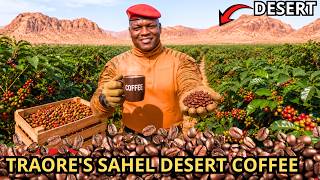
Nobody Believed The Desert Could Grow COFFEE — Until TRAORE Did
リアクション
2026年06月08日
Burkina Faso’s agricultural transformation has become one of the most talked-about development stories in AFRICA, capturing the attention of policymakers, economists, farmers, and citizens who are closely watching the country's pursuit of greater self-reliance. Once widely viewed as a nation constrained by harsh climatic conditions, recurring droughts, and dependence on imported food, Burkina Faso is now attempting to rewrite its future through a bold strategy centered on food sovereignty, agricultural modernization, and national resilience.
In this video, we explore how the country has placed agriculture at the heart of its long-term development vision. Rather than treating food production as simply an economic activity, Burkina Faso has increasingly framed it as a matter of national independence. The objective is not only to grow more crops but also to reduce vulnerability to global market disruptions, strengthen domestic production, and increase the nation’s ability to determine its own priorities.
A major part of this transformation involves the modernization of farming practices. Across various regions, farmers are gaining access to tractors, irrigation equipment, improved seeds, and modern agricultural techniques designed to increase productivity and expand cultivation capacity. These efforts are helping move agriculture beyond traditional subsistence models toward a more organized and strategic sector capable of supporting broader economic growth.
Water management has also emerged as a critical pillar of this agricultural push. In a country where rainfall patterns can be unpredictable, investments in reservoirs, irrigation systems, canals, and pumping infrastructure are helping create more reliable conditions for farming. Projects associated with key agricultural zones demonstrate how access to water can unlock previously underutilized land and support year-round production.
One of the most fascinating aspects of this story is the experimentation with crops that many once believed could never thrive in parts of Burkina Faso. Through targeted irrigation, improved cultivation techniques, and carefully managed environments, farmers are exploring opportunities involving crops such as apples, strawberries, cocoa, coffee, and pineapples. While these projects remain limited in scale compared to staple food production, they symbolize a broader willingness to challenge assumptions and expand agricultural possibilities.
Beyond production, Burkina Faso is also focusing on local processing and value creation. Rice mills, tomato processing facilities, cashew operations, and other agro-industrial initiatives are designed to ensure that more economic value remains within the country. By connecting farms to factories, transportation networks, and consumer markets, the nation hopes to create jobs, strengthen domestic industries, and reduce dependence on imported processed goods.
At the center of much of this discussion is Captain Ibrahim Traoré, whose administration has repeatedly emphasized the connection between agriculture, sovereignty, and national development. Supporters argue that food production should be viewed alongside other strategic sectors such as energy and infrastructure. Critics, however, question whether the current momentum can be sustained given ongoing challenges related to security, financing, governance, and climate pressures.
This video examines both sides of the debate. We look at the achievements being highlighted by supporters, the concerns raised by critics, and the larger questions surrounding development, self-determination, and resilience. The discussion extends beyond a single country and raises issues relevant to many nations across the continent.
As AFRICA NEWS continues to follow major developments shaping the continent, Burkina Faso’s agricultural experiment provides an important case study in how countries seek to balance ambition with reality. Its experience is generating conversations throughout West Africa and beyond, influencing discussions about economic independence, food systems, and long-term national planning.
The implications also reach wider regional institutions and movements. Observers interested in the future role of the AFRICAN UNION, the vision of Pan Africa, and the evolving development strategies of countries including South Africa are paying close attention to the lessons emerging from Burkina Faso’s experience.
#IbrahimTraore
#BurkinaFaso
#CaptainIbrahimTraore
#IbrahimTraoré
#Goita
#MALI
#AES
In this video, we explore how the country has placed agriculture at the heart of its long-term development vision. Rather than treating food production as simply an economic activity, Burkina Faso has increasingly framed it as a matter of national independence. The objective is not only to grow more crops but also to reduce vulnerability to global market disruptions, strengthen domestic production, and increase the nation’s ability to determine its own priorities.
A major part of this transformation involves the modernization of farming practices. Across various regions, farmers are gaining access to tractors, irrigation equipment, improved seeds, and modern agricultural techniques designed to increase productivity and expand cultivation capacity. These efforts are helping move agriculture beyond traditional subsistence models toward a more organized and strategic sector capable of supporting broader economic growth.
Water management has also emerged as a critical pillar of this agricultural push. In a country where rainfall patterns can be unpredictable, investments in reservoirs, irrigation systems, canals, and pumping infrastructure are helping create more reliable conditions for farming. Projects associated with key agricultural zones demonstrate how access to water can unlock previously underutilized land and support year-round production.
One of the most fascinating aspects of this story is the experimentation with crops that many once believed could never thrive in parts of Burkina Faso. Through targeted irrigation, improved cultivation techniques, and carefully managed environments, farmers are exploring opportunities involving crops such as apples, strawberries, cocoa, coffee, and pineapples. While these projects remain limited in scale compared to staple food production, they symbolize a broader willingness to challenge assumptions and expand agricultural possibilities.
Beyond production, Burkina Faso is also focusing on local processing and value creation. Rice mills, tomato processing facilities, cashew operations, and other agro-industrial initiatives are designed to ensure that more economic value remains within the country. By connecting farms to factories, transportation networks, and consumer markets, the nation hopes to create jobs, strengthen domestic industries, and reduce dependence on imported processed goods.
At the center of much of this discussion is Captain Ibrahim Traoré, whose administration has repeatedly emphasized the connection between agriculture, sovereignty, and national development. Supporters argue that food production should be viewed alongside other strategic sectors such as energy and infrastructure. Critics, however, question whether the current momentum can be sustained given ongoing challenges related to security, financing, governance, and climate pressures.
This video examines both sides of the debate. We look at the achievements being highlighted by supporters, the concerns raised by critics, and the larger questions surrounding development, self-determination, and resilience. The discussion extends beyond a single country and raises issues relevant to many nations across the continent.
As AFRICA NEWS continues to follow major developments shaping the continent, Burkina Faso’s agricultural experiment provides an important case study in how countries seek to balance ambition with reality. Its experience is generating conversations throughout West Africa and beyond, influencing discussions about economic independence, food systems, and long-term national planning.
The implications also reach wider regional institutions and movements. Observers interested in the future role of the AFRICAN UNION, the vision of Pan Africa, and the evolving development strategies of countries including South Africa are paying close attention to the lessons emerging from Burkina Faso’s experience.
#IbrahimTraore
#BurkinaFaso
#CaptainIbrahimTraore
#IbrahimTraoré
#Goita
#MALI
#AES