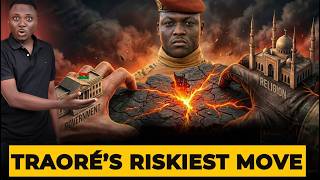
The Religion Ban That Has Saudi Arabia and Qatar Panicking
リアクション
2026年05月30日
Ibrahim Traoré just banned religion from Burkina Faso's government buildings — and the Sahel may never be the same. Inside the most controversial African leadership decision of 2025, the real story behind Burkina Faso's secular crackdown, foreign mosque funding, and what it means for African sovereignty.
Is this African self-determination or dangerous authoritarianism? We break down why over 80% of Sahel mosques are financed by Saudi Arabia and Qatar, what the arrest of the Imam of the Kaaba tells us about global double standards, and why Burkina Faso's constitution has been secular since 1991 — long before Traoré ever took power.
We also examine how both Islam and Christianity arrived in Africa — and what was destroyed in the process. From the Sokoto Jihad to European missionary coercion, this is the historical context that mainstream media consistently leaves out.
Rwanda's Kagame closed thousands of churches. France separated church from state in 1905. The United States did it in 1791. Africa is having that conversation right now — and the loudest opposition is often funded from the outside.
This is not a debate about faith. It is a debate about who the African state actually serves.
📌 SOURCES USED IN THIS VIDEO
Information in this video was drawn from the CIA World Factbook (Burkina Faso country profile), the Constitution of Burkina Faso (1991) via Constitute Project, Carnegie Endowment for International Peace (foreign funding of religion in the Sahel), ACLED conflict data (Burkina Faso 2024), BBC Africa, The Africa Report, Premium Times Nigeria, Middle East Eye, RFI Africa, Encyclopaedia Britannica, Walter Rodney's "How Europe Underdeveloped Africa," and the National Archives of the United States. All claims are sourced. We encourage you to verify independently.
⚠️ DISCLAIMER
This video is produced strictly for educational, analytical, and informational purposes. The Strategic Lens does not promote, endorse, or condone any form of religious discrimination, ethnic hostility, or political violence. All perspectives presented are grounded in documented sources and examined through a geopolitical and historical lens. Criticism of foreign funding networks or state policy is not an attack on any faith community or its members. We distinguish clearly between ordinary believers and the political or financial structures that sometimes operate in the name of religion. Viewers are encouraged to think critically, consult primary sources, and form their own conclusions. Nothing in this video constitutes legal, political, or religious advice.
🔗 WANT DEEPER ANALYSIS? JOIN THE COMMUNITY
For exclusive content, early access to episodes, and members-only strategic briefings on African geopolitics and development — join our membership:
👉 TO JOIN OUR MEMBERSHIP CLICK THE LINK https://www.patreon.com/AfricaTodayClub763
#BurkinaFaso #IbrahimTraore #AfricanGeopolitics
JOIN OUR MEMBERSHIP THROUGH
https://www.youtube.com/channel/UCQhku_T68i-szD9Qjv9YmTA/join
OUR PAYPAL
http://paypal.me/AfricaToday
Don't forget to Like, Share and Subscribe
Captain Ibrahim Traore's recent actions have brought the intersection of government and religion into sharp focus, especially concerning the role of Islam in governance. The video explores historical depictions of colonial encounters and contemporary events, including instances of public prayer. This situation prompts important questions about Islamic history and the concept of jihad in modern contexts.
Is this African self-determination or dangerous authoritarianism? We break down why over 80% of Sahel mosques are financed by Saudi Arabia and Qatar, what the arrest of the Imam of the Kaaba tells us about global double standards, and why Burkina Faso's constitution has been secular since 1991 — long before Traoré ever took power.
We also examine how both Islam and Christianity arrived in Africa — and what was destroyed in the process. From the Sokoto Jihad to European missionary coercion, this is the historical context that mainstream media consistently leaves out.
Rwanda's Kagame closed thousands of churches. France separated church from state in 1905. The United States did it in 1791. Africa is having that conversation right now — and the loudest opposition is often funded from the outside.
This is not a debate about faith. It is a debate about who the African state actually serves.
📌 SOURCES USED IN THIS VIDEO
Information in this video was drawn from the CIA World Factbook (Burkina Faso country profile), the Constitution of Burkina Faso (1991) via Constitute Project, Carnegie Endowment for International Peace (foreign funding of religion in the Sahel), ACLED conflict data (Burkina Faso 2024), BBC Africa, The Africa Report, Premium Times Nigeria, Middle East Eye, RFI Africa, Encyclopaedia Britannica, Walter Rodney's "How Europe Underdeveloped Africa," and the National Archives of the United States. All claims are sourced. We encourage you to verify independently.
⚠️ DISCLAIMER
This video is produced strictly for educational, analytical, and informational purposes. The Strategic Lens does not promote, endorse, or condone any form of religious discrimination, ethnic hostility, or political violence. All perspectives presented are grounded in documented sources and examined through a geopolitical and historical lens. Criticism of foreign funding networks or state policy is not an attack on any faith community or its members. We distinguish clearly between ordinary believers and the political or financial structures that sometimes operate in the name of religion. Viewers are encouraged to think critically, consult primary sources, and form their own conclusions. Nothing in this video constitutes legal, political, or religious advice.
🔗 WANT DEEPER ANALYSIS? JOIN THE COMMUNITY
For exclusive content, early access to episodes, and members-only strategic briefings on African geopolitics and development — join our membership:
👉 TO JOIN OUR MEMBERSHIP CLICK THE LINK https://www.patreon.com/AfricaTodayClub763
#BurkinaFaso #IbrahimTraore #AfricanGeopolitics
JOIN OUR MEMBERSHIP THROUGH
https://www.youtube.com/channel/UCQhku_T68i-szD9Qjv9YmTA/join
OUR PAYPAL
http://paypal.me/AfricaToday
Don't forget to Like, Share and Subscribe
Captain Ibrahim Traore's recent actions have brought the intersection of government and religion into sharp focus, especially concerning the role of Islam in governance. The video explores historical depictions of colonial encounters and contemporary events, including instances of public prayer. This situation prompts important questions about Islamic history and the concept of jihad in modern contexts.