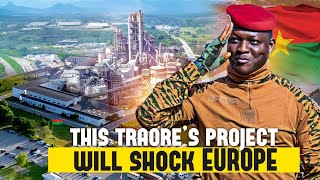
IMPRESSIVE - Ibrahim Traore is Transforming Burkina Faso With These 5 Game Changing FACTORIES
リアクション
2026年04月03日
IMPRESSIVE - Ibrahim Traore is Transforming Burkina Faso With These 5 Game Changing FACTORIES
In the heart of West Africa, a quiet but powerful industrial transformation is beginning to unfold in Burkina Faso under the leadership of Ibrahim traore, The Young African Revolutionary leader.
For decades, the story of many African economies followed a familiar pattern. The continent exported its raw wealth to the rest of the world — gold, cotton, agricultural produce, and minerals — only to buy back finished products at far higher prices. Gold mined from African soil was refined overseas. Crops grown by African farmers were processed in foreign factories. Technology used by millions across the continent was manufactured thousands of miles away.
This cycle kept many countries dependent on external industries while limiting their ability to build strong domestic economies.
But now, a bold new vision is emerging in Burkina Faso.
Under the leadership of Ibrahim Traoré, one of the youngest heads of state in the world, the country is taking steps to change that narrative. After Kicking out France and fighting for the sovereignty of the country, Traore is now fighting for the economic Sovereignty of Burkina Faso
Instead of simply exporting raw resources, Burkina Faso is now investing in building its own industries.
In a series of ambitious projects, Traoré has launched major factories aimed at transforming the country’s economic landscape. These projects focus on key sectors that shape modern economies — agriculture, mineral processing, waste recycling and technology manufacturing.
The goal is simple but revolutionary: produce more at home, create jobs locally, and reduce dependence on imports.
Among the most striking initiatives are a tomato processing plant designed to support local farmers, a gold refinery that will allow the country to process its own precious metals, and even a mobile phone assembly factory, a rare step toward technological manufacturing in the region.
If successful, these projects could mark a turning point not only for Burkina Faso but also for how smaller African economies approach development in the 21st century.
Supporters say these factories represent the beginning of a new industrial era.
Critics say the road ahead will be difficult.
But one thing is certain — something significant is beginning to take shape.
So what exactly are these factories?
How will they work?
And could they truly reshape the economic future of Burkina Faso?
Let’s take a closer look.
1. An $8 Million Tomatoes Processing Plant.
In Burkina Faso, agriculture has always been the backbone of the economy. Millions of people rely on farming for their livelihoods, and tomatoes are one of the most widely cultivated crops in the country. Yet for years, farmers faced a frustrating and costly problem: during peak harvest seasons, huge quantities of tomatoes spoiled before they could be sold. Without sufficient storage facilities or processing plants, farmers were often forced to sell their produce at extremely low prices or watch it rot in the fields. This cycle of waste and lost income limited the potential of the agricultural sector. It was this challenge that pushed the government led by Ibrahim Traoré to launch an ambitious new solution — an $8-million tomato processing plant designed to transform the country’s agricultural value chain.
The factory was created to solve several problems at once. First, it aims to reduce the massive post-harvest losses that farmers experience each year. Second, it helps Burkina Faso move away from the long-standing economic model in which raw agricultural goods are exported cheaply while processed food products are imported at higher prices. For decades, even tomato paste sold in local markets often came from foreign factories, despite the abundance of tomatoes grown locally. By building a domestic processing plant, the government hopes to ensure that more of the value created by agriculture stays inside the country.
The plant operates as a large-scale food processing facility that converts fresh tomatoes into products with a longer shelf life. Farmers from surrounding agricultural regions deliver truckloads of freshly harvested tomatoes to the factory. Once the tomatoes arrive, they go through a series of processing stages. First, they are sorted and cleaned to remove damaged fruit and debris. Next, the tomatoes are crushed and cooked in industrial equipment that extracts pulp and concentrates the flavor. This process produces tomato paste, which can then be packaged in cans, sachets, or containers for distribution. The factory also produces other tomato-based products such as sauces and puree. Because these products can last much longer than fresh tomatoes, they can be stored, transported, and
In the heart of West Africa, a quiet but powerful industrial transformation is beginning to unfold in Burkina Faso under the leadership of Ibrahim traore, The Young African Revolutionary leader.
For decades, the story of many African economies followed a familiar pattern. The continent exported its raw wealth to the rest of the world — gold, cotton, agricultural produce, and minerals — only to buy back finished products at far higher prices. Gold mined from African soil was refined overseas. Crops grown by African farmers were processed in foreign factories. Technology used by millions across the continent was manufactured thousands of miles away.
This cycle kept many countries dependent on external industries while limiting their ability to build strong domestic economies.
But now, a bold new vision is emerging in Burkina Faso.
Under the leadership of Ibrahim Traoré, one of the youngest heads of state in the world, the country is taking steps to change that narrative. After Kicking out France and fighting for the sovereignty of the country, Traore is now fighting for the economic Sovereignty of Burkina Faso
Instead of simply exporting raw resources, Burkina Faso is now investing in building its own industries.
In a series of ambitious projects, Traoré has launched major factories aimed at transforming the country’s economic landscape. These projects focus on key sectors that shape modern economies — agriculture, mineral processing, waste recycling and technology manufacturing.
The goal is simple but revolutionary: produce more at home, create jobs locally, and reduce dependence on imports.
Among the most striking initiatives are a tomato processing plant designed to support local farmers, a gold refinery that will allow the country to process its own precious metals, and even a mobile phone assembly factory, a rare step toward technological manufacturing in the region.
If successful, these projects could mark a turning point not only for Burkina Faso but also for how smaller African economies approach development in the 21st century.
Supporters say these factories represent the beginning of a new industrial era.
Critics say the road ahead will be difficult.
But one thing is certain — something significant is beginning to take shape.
So what exactly are these factories?
How will they work?
And could they truly reshape the economic future of Burkina Faso?
Let’s take a closer look.
1. An $8 Million Tomatoes Processing Plant.
In Burkina Faso, agriculture has always been the backbone of the economy. Millions of people rely on farming for their livelihoods, and tomatoes are one of the most widely cultivated crops in the country. Yet for years, farmers faced a frustrating and costly problem: during peak harvest seasons, huge quantities of tomatoes spoiled before they could be sold. Without sufficient storage facilities or processing plants, farmers were often forced to sell their produce at extremely low prices or watch it rot in the fields. This cycle of waste and lost income limited the potential of the agricultural sector. It was this challenge that pushed the government led by Ibrahim Traoré to launch an ambitious new solution — an $8-million tomato processing plant designed to transform the country’s agricultural value chain.
The factory was created to solve several problems at once. First, it aims to reduce the massive post-harvest losses that farmers experience each year. Second, it helps Burkina Faso move away from the long-standing economic model in which raw agricultural goods are exported cheaply while processed food products are imported at higher prices. For decades, even tomato paste sold in local markets often came from foreign factories, despite the abundance of tomatoes grown locally. By building a domestic processing plant, the government hopes to ensure that more of the value created by agriculture stays inside the country.
The plant operates as a large-scale food processing facility that converts fresh tomatoes into products with a longer shelf life. Farmers from surrounding agricultural regions deliver truckloads of freshly harvested tomatoes to the factory. Once the tomatoes arrive, they go through a series of processing stages. First, they are sorted and cleaned to remove damaged fruit and debris. Next, the tomatoes are crushed and cooked in industrial equipment that extracts pulp and concentrates the flavor. This process produces tomato paste, which can then be packaged in cans, sachets, or containers for distribution. The factory also produces other tomato-based products such as sauces and puree. Because these products can last much longer than fresh tomatoes, they can be stored, transported, and