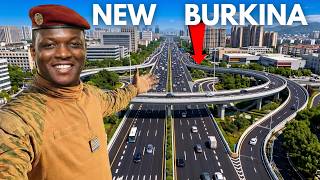
How Traoré Built Africa’s Biggest Highway in 40 Days?
リアクション
2026年06月28日
Burkina Faso is changing fast under Captain Ibrahim Traoré, and this video follows the roads, ring roads, expressways, and mega-projects that are reshaping the country in real time. From the 332-kilometer Ouagadougou–Bobo-Dioulasso Highway launched in late 2025 under Faso Mêbo, to the brand-new urban road networks opened across Ouagadougou in 2026, this is far more than a construction story. It's the story of how Burkina Faso is investing in infrastructure, transport, logistics, and national development while pursuing a new vision of economic sovereignty under Captain Ibrahim Traoré.
ℹ️If this documentary made you proud to see our continent stand on its own feet, the best way to support our work is to watch, share, and subscribe. Want to help us tell more stories like this? Every contribution helps us remain independent, dig deeper, and produce the next documentary that tells Africa's story from an African perspective.
🎯 Support our work here 👇🏾
https://arisennow.gumroad.com/l/tipjar
Together, we can help Africa tell its own story and arise again. Thank you for believing in Africa and for being part of this mission. God bless you🙏🏼❤
Starting in the capital, the route map stretches across Rocade Nord, RN4, RN2, Avenue du Moogho Naaba, Yennenga Avenue, and new access roads before expanding into a nationwide highway network. From the Bobo-Dioulasso–Banfora corridor, the Banfora–Orodara road, RN11 toward Gaoua, RN22, RN10, and the Kaya–Barsalogho road, this video explores how Burkina Faso is connecting its cities, agricultural regions, security corridors, and international trade routes. Together, these projects reveal a coordinated national infrastructure strategy rather than isolated road upgrades.
One of the biggest questions surrounding Captain Ibrahim Traoré is whether these projects are laying the foundation for something even larger. We also examine the growing role of the Alliance of Sahel States (AES)—the regional bloc formed by Burkina Faso, Mali, and Niger. With Captain Ibrahim Traoré, Assimi Goïta, and Abdourahamane Tiani leading their respective countries, many observers have noticed that new transport corridors increasingly point toward Ouagadougou, Bamako, and Niamey. While governments have not announced a single cross-border highway masterplan, this video explores how expanding road networks, regional logistics, and infrastructure investment could strengthen trade, security cooperation, and economic integration across the Sahel.
The western trade corridor is especially significant. The Bobo-Dioulasso–Banfora road and the Banfora–Orodara corridor form part of Burkina Faso's vital connection to regional markets. As a landlocked country, Burkina Faso depends heavily on reliable transport routes linking it to ports such as Abidjan in Côte d'Ivoire. That's why highways, freight corridors, bridges, logistics, cross-border commerce, and regional connectivity have become central to the country's long-term development strategy under Captain Ibrahim Traoré.
Beyond the highways themselves, this documentary explores Faso Mêbo, Burkinabè engineering, military engineers, locally owned construction equipment, and the government's effort to expand national infrastructure using domestic resources. We also examine how these road projects connect with agriculture, mining, regional trade, economic development, national security, and the future of the Alliance of Sahel States. Whether you're interested in Burkina Faso, Captain Ibrahim Traoré, Mali, Niger, African infrastructure, mega projects, geopolitics, transport corridors, or the future of the Sahel, this video brings together maps, on-the-ground footage, official project updates, and detailed analysis to explain why so many people are closely watching Burkina Faso's infrastructure transformation.
ℹ️If this documentary made you proud to see our continent stand on its own feet, the best way to support our work is to watch, share, and subscribe. Want to help us tell more stories like this? Every contribution helps us remain independent, dig deeper, and produce the next documentary that tells Africa's story from an African perspective.
🎯 Support our work here 👇🏾
https://arisennow.gumroad.com/l/tipjar
Together, we can help Africa tell its own story and arise again. Thank you for believing in Africa and for being part of this mission. God bless you🙏🏼❤
Starting in the capital, the route map stretches across Rocade Nord, RN4, RN2, Avenue du Moogho Naaba, Yennenga Avenue, and new access roads before expanding into a nationwide highway network. From the Bobo-Dioulasso–Banfora corridor, the Banfora–Orodara road, RN11 toward Gaoua, RN22, RN10, and the Kaya–Barsalogho road, this video explores how Burkina Faso is connecting its cities, agricultural regions, security corridors, and international trade routes. Together, these projects reveal a coordinated national infrastructure strategy rather than isolated road upgrades.
One of the biggest questions surrounding Captain Ibrahim Traoré is whether these projects are laying the foundation for something even larger. We also examine the growing role of the Alliance of Sahel States (AES)—the regional bloc formed by Burkina Faso, Mali, and Niger. With Captain Ibrahim Traoré, Assimi Goïta, and Abdourahamane Tiani leading their respective countries, many observers have noticed that new transport corridors increasingly point toward Ouagadougou, Bamako, and Niamey. While governments have not announced a single cross-border highway masterplan, this video explores how expanding road networks, regional logistics, and infrastructure investment could strengthen trade, security cooperation, and economic integration across the Sahel.
The western trade corridor is especially significant. The Bobo-Dioulasso–Banfora road and the Banfora–Orodara corridor form part of Burkina Faso's vital connection to regional markets. As a landlocked country, Burkina Faso depends heavily on reliable transport routes linking it to ports such as Abidjan in Côte d'Ivoire. That's why highways, freight corridors, bridges, logistics, cross-border commerce, and regional connectivity have become central to the country's long-term development strategy under Captain Ibrahim Traoré.
Beyond the highways themselves, this documentary explores Faso Mêbo, Burkinabè engineering, military engineers, locally owned construction equipment, and the government's effort to expand national infrastructure using domestic resources. We also examine how these road projects connect with agriculture, mining, regional trade, economic development, national security, and the future of the Alliance of Sahel States. Whether you're interested in Burkina Faso, Captain Ibrahim Traoré, Mali, Niger, African infrastructure, mega projects, geopolitics, transport corridors, or the future of the Sahel, this video brings together maps, on-the-ground footage, official project updates, and detailed analysis to explain why so many people are closely watching Burkina Faso's infrastructure transformation.