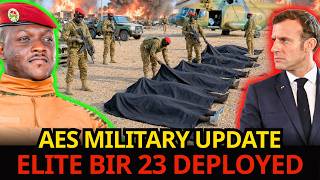
WATCH How TRAORE'S Elite BIR 23 Hunted Down Extremists In The SOURROU Valley
リアクション
2026年06月24日
In the shifting security landscape of West Africa, few developments have drawn as much attention as the recent operation carried out by Burkina Faso’s elite BIR 23 unit in the Sourou Valley. What appeared at first to be a tactical strike against a JNIM position in Bangasso has become a powerful example of how modern security strategies are evolving across the Sahel.
After days of surveillance, intelligence gathering, and careful planning, BIR 23 launched a precise operation that resulted in the destruction of a militant base and the seizure of valuable equipment, including weapons, communication systems, and mobility assets. The mission demonstrated that successful military action is no longer defined solely by force, but increasingly by information, patience, and strategic execution.
For many observers, this operation highlights a broader transformation taking place inside Burkina Faso. Rather than waiting to respond after attacks occur, security forces are increasingly focused on identifying threats early, disrupting hostile networks, and preventing future violence before it can unfold. This proactive approach has become a central feature of the country's evolving security doctrine.
The significance of the Bangasso operation extends far beyond a single battlefield success. The Sourou Valley has long been considered a strategically important region where armed groups have sought to exploit difficult terrain and movement corridors. By targeting and dismantling infrastructure used by extremists, Burkina Faso demonstrated its growing capacity to challenge networks that once operated with greater freedom.
An important factor behind this success is the growing reputation of BIR 23. The unit has become known for combining intelligence-driven planning with disciplined execution. Rather than relying exclusively on overwhelming force, it emphasizes preparation, timing, and initiative. These qualities have allowed the formation to emerge as one of the most closely watched military units in the region.
The operation also reflects wider conversations about sovereignty, security, and regional cooperation. Across the Sahel, countries are increasingly exploring ways to strengthen local capabilities and reduce dependence on external solutions. This discussion has become particularly important as nations seek responses tailored to their own realities and challenges.
Under the leadership of Ibrahim Traore, Burkina Faso has pursued policies that place greater emphasis on territorial control, community confidence, and proactive security measures. Supporters argue that these efforts represent a necessary response to years of instability, while critics continue to debate the broader political and economic implications. Regardless of perspective, the impact of these developments remains a major topic throughout the region.
The growing cooperation among Burkina Faso, Mali, and Niger through the Alliance of Sahel States has added another dimension to this transformation. Shared intelligence, coordinated planning, and common security objectives are increasingly viewed as essential tools in confronting threats that move across national borders. Many supporters see this cooperation as an important step toward stronger regional resilience.
Beyond military discussions, the events unfolding across the Sahel have sparked renewed interest in larger ideas about African self-determination and regional responsibility. Conversations involving Pan-African values, the future role of the African Union, and the meaning of PanAfricanism continue to shape public debate. These discussions are not only about security but also about how African nations can define their own paths forward.
The Bangasso operation has therefore become more than a story about a successful mission. It represents a moment within a broader movement that many describe as Africa new, where governments, communities, and institutions seek to build solutions from within. Figures such as Captain IbrahimTraore have become central to these conversations, attracting attention far beyond their national borders.
As debate continues regarding the role of international partners, including France, and as media platforms such as AfricanDiasporaNewsChannel contribute to public discussion, one thing remains clear: the future of the Sahel will be shaped by decisions made both on the battlefield and within society itself.
Here on AFRICA RISING VIEW, we continue to explore the stories, strategies, and transformations that are influencing the future of the continent. The operation in Bangasso offers valuable insight into how security, cooperation, and self-reliance are becoming defining themes across the region.
#IbrahimTraore
#BurkinaFaso
#CaptainIbrahimTraore
#IbrahimTraoré
#Goita
#Maliwar
#Kidal
#MALI
#AES
After days of surveillance, intelligence gathering, and careful planning, BIR 23 launched a precise operation that resulted in the destruction of a militant base and the seizure of valuable equipment, including weapons, communication systems, and mobility assets. The mission demonstrated that successful military action is no longer defined solely by force, but increasingly by information, patience, and strategic execution.
For many observers, this operation highlights a broader transformation taking place inside Burkina Faso. Rather than waiting to respond after attacks occur, security forces are increasingly focused on identifying threats early, disrupting hostile networks, and preventing future violence before it can unfold. This proactive approach has become a central feature of the country's evolving security doctrine.
The significance of the Bangasso operation extends far beyond a single battlefield success. The Sourou Valley has long been considered a strategically important region where armed groups have sought to exploit difficult terrain and movement corridors. By targeting and dismantling infrastructure used by extremists, Burkina Faso demonstrated its growing capacity to challenge networks that once operated with greater freedom.
An important factor behind this success is the growing reputation of BIR 23. The unit has become known for combining intelligence-driven planning with disciplined execution. Rather than relying exclusively on overwhelming force, it emphasizes preparation, timing, and initiative. These qualities have allowed the formation to emerge as one of the most closely watched military units in the region.
The operation also reflects wider conversations about sovereignty, security, and regional cooperation. Across the Sahel, countries are increasingly exploring ways to strengthen local capabilities and reduce dependence on external solutions. This discussion has become particularly important as nations seek responses tailored to their own realities and challenges.
Under the leadership of Ibrahim Traore, Burkina Faso has pursued policies that place greater emphasis on territorial control, community confidence, and proactive security measures. Supporters argue that these efforts represent a necessary response to years of instability, while critics continue to debate the broader political and economic implications. Regardless of perspective, the impact of these developments remains a major topic throughout the region.
The growing cooperation among Burkina Faso, Mali, and Niger through the Alliance of Sahel States has added another dimension to this transformation. Shared intelligence, coordinated planning, and common security objectives are increasingly viewed as essential tools in confronting threats that move across national borders. Many supporters see this cooperation as an important step toward stronger regional resilience.
Beyond military discussions, the events unfolding across the Sahel have sparked renewed interest in larger ideas about African self-determination and regional responsibility. Conversations involving Pan-African values, the future role of the African Union, and the meaning of PanAfricanism continue to shape public debate. These discussions are not only about security but also about how African nations can define their own paths forward.
The Bangasso operation has therefore become more than a story about a successful mission. It represents a moment within a broader movement that many describe as Africa new, where governments, communities, and institutions seek to build solutions from within. Figures such as Captain IbrahimTraore have become central to these conversations, attracting attention far beyond their national borders.
As debate continues regarding the role of international partners, including France, and as media platforms such as AfricanDiasporaNewsChannel contribute to public discussion, one thing remains clear: the future of the Sahel will be shaped by decisions made both on the battlefield and within society itself.
Here on AFRICA RISING VIEW, we continue to explore the stories, strategies, and transformations that are influencing the future of the continent. The operation in Bangasso offers valuable insight into how security, cooperation, and self-reliance are becoming defining themes across the region.
#IbrahimTraore
#BurkinaFaso
#CaptainIbrahimTraore
#IbrahimTraoré
#Goita
#Maliwar
#Kidal
#MALI
#AES












![[[PV] チェ・ジユ (Choi Jiyu) - 眩しい夏 (Dazzling Summer)](https://img.youtube.com/vi/SaAQqyT1vCw/mqdefault.jpg)