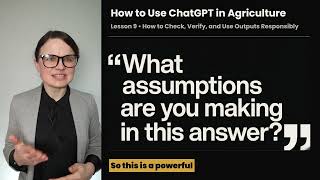
How to use ChatGPT in Agriculture: Lesson 9 - How to Check, Verify, and Use Outputs Responsibly
リアクション
2026年04月10日
Welcome to Lesson 9 of *How to Use ChatGPT in Agriculture* — a practical lesson about one of the most important parts of using AI responsibly in farming and agri-business: how to verify ChatGPT outputs before using them in real agricultural work.
Artificial intelligence can be extremely useful in agriculture, but only when it is used with care, judgement & verification. In this lesson, we focus on a core principle that every farmer, agronomist, agricultural consultant, researcher, student & agri-business professional should understand: *verification is not optional* — it is part of the workflow.
If you are using ChatGPT in agriculture, this lesson will help you understand when AI-generated outputs are helpful, when they need checking & how to build a more professional and realistic workflow around them. Agriculture is full of context-sensitive decisions. Advice related to crops, livestock, compliance, plant health, animal welfare, finances, chemicals, regulation, and disease cannot be accepted blindly. That is exactly why this lesson matters.
Inside this lesson, you will learn how to use ChatGPT more safely and responsibly by identifying what types of outputs require the most careful review, what kinds of prompts can encourage more transparent answers & which agricultural use cases are strongest for AI support. The lesson also explains why confidence in wording does not always mean correctness in content.
This is especially important in modern farming, where digital tools are increasingly used for planning, communication, reporting, technical explanations, agronomy support, and decision preparation. AI in agriculture can help save time and structure information, but the final responsibility still belongs to the human user. The more serious the decision, the more careful the verification should be.
In this lesson, we cover practical examples of what to verify first. That includes:
hard facts, calculations, chemical statements, regulatory statements, disease-related context, and any output that could create real-world harm if it is wrong. This is essential knowledge for anyone exploring ChatGPT for farmers, ChatGPT for agronomists, AI tools for agriculture, farm management AI, or generative AI in agriculture.
You will also see practical verification prompts that help make AI use more responsible. For example, instead of simply accepting an answer, you can ask ChatGPT to reveal its assumptions. This helps expose where important local context may be missing. You can also encourage the model to express uncertainty rather than presenting everything with the same confidence. These small changes can significantly improve how you interpret and use AI outputs in agricultural workflows.
The lesson also explains where ChatGPT is often strongest & safest. Some of the best use cases include:
drafting, structuring, training, communication, summarising, comparing & planning. These are areas where AI can provide strong value without requiring blind trust. Used properly, ChatGPT can help farmers and agri-professionals think more clearly, communicate more effectively & organise work more efficiently.
This lesson is part of a beginner-friendly course created to help people across agriculture use ChatGPT in a useful, realistic & responsible way. Whether you work in crop production, horticulture, advisory services, agri-tech, education, research, or farm operations, this lesson will help you build a safer & more professional AI workflow.
If you are searching for:
how to verify ChatGPT answers,
how to use AI safely in agriculture,
ChatGPT for farm decision support,
responsible AI in farming,
how farmers should use ChatGPT,
or best practices for ChatGPT in agriculture,
this lesson is for you.
*Timestamps*
00:07 Welcome to Lesson 9
00:14 Goal of the lesson: use ChatGPT safely, professionally and realistically
00:23 Verification is part of the workflow
00:31 Why verification matters in agriculture
00:46 What to verify first
01:14 Practical verification prompt: reveal assumptions
01:24 Missing local context and human review
01:33 Prompting for uncertainty instead of false confidence
01:42 Best & safest use cases for ChatGPT
01:50 Drafting, structuring, training, communication, summarising, comparing and planning
02:06 When not to stop at ChatGPT
02:14 Safety, legality, compliance, plant health, animal welfare & financial decisions
02:32 Use ChatGPT as a starting point, not the final checkpoint
#AIinAgriculture #drmarynakuzmenko #chatgptforbeginners
*DR. MARYNA KUZMENKO*
Website: https://marynakuzmenko.com
Linkedin: https://www.linkedin.com/in/kuzmenkomaryna/
Instagram: https://instagram.com/dr.maryna.kuzmenko
TikTok: https://tiktok.com/@dr.maryna.kuzmenko
X: https://x.com/mary_kuzmenko
Facebook: https://www.facebook.com/dr.maryna.kuzmenko
_
🎁👉 FREE online beginner-level course "AI in Agriculture: Practical Introductory Course" on Udemy: https://www.udemy.com/course/ai-in-agriculture/?referralCode=19C904CE9CE14A84F14
Artificial intelligence can be extremely useful in agriculture, but only when it is used with care, judgement & verification. In this lesson, we focus on a core principle that every farmer, agronomist, agricultural consultant, researcher, student & agri-business professional should understand: *verification is not optional* — it is part of the workflow.
If you are using ChatGPT in agriculture, this lesson will help you understand when AI-generated outputs are helpful, when they need checking & how to build a more professional and realistic workflow around them. Agriculture is full of context-sensitive decisions. Advice related to crops, livestock, compliance, plant health, animal welfare, finances, chemicals, regulation, and disease cannot be accepted blindly. That is exactly why this lesson matters.
Inside this lesson, you will learn how to use ChatGPT more safely and responsibly by identifying what types of outputs require the most careful review, what kinds of prompts can encourage more transparent answers & which agricultural use cases are strongest for AI support. The lesson also explains why confidence in wording does not always mean correctness in content.
This is especially important in modern farming, where digital tools are increasingly used for planning, communication, reporting, technical explanations, agronomy support, and decision preparation. AI in agriculture can help save time and structure information, but the final responsibility still belongs to the human user. The more serious the decision, the more careful the verification should be.
In this lesson, we cover practical examples of what to verify first. That includes:
hard facts, calculations, chemical statements, regulatory statements, disease-related context, and any output that could create real-world harm if it is wrong. This is essential knowledge for anyone exploring ChatGPT for farmers, ChatGPT for agronomists, AI tools for agriculture, farm management AI, or generative AI in agriculture.
You will also see practical verification prompts that help make AI use more responsible. For example, instead of simply accepting an answer, you can ask ChatGPT to reveal its assumptions. This helps expose where important local context may be missing. You can also encourage the model to express uncertainty rather than presenting everything with the same confidence. These small changes can significantly improve how you interpret and use AI outputs in agricultural workflows.
The lesson also explains where ChatGPT is often strongest & safest. Some of the best use cases include:
drafting, structuring, training, communication, summarising, comparing & planning. These are areas where AI can provide strong value without requiring blind trust. Used properly, ChatGPT can help farmers and agri-professionals think more clearly, communicate more effectively & organise work more efficiently.
This lesson is part of a beginner-friendly course created to help people across agriculture use ChatGPT in a useful, realistic & responsible way. Whether you work in crop production, horticulture, advisory services, agri-tech, education, research, or farm operations, this lesson will help you build a safer & more professional AI workflow.
If you are searching for:
how to verify ChatGPT answers,
how to use AI safely in agriculture,
ChatGPT for farm decision support,
responsible AI in farming,
how farmers should use ChatGPT,
or best practices for ChatGPT in agriculture,
this lesson is for you.
*Timestamps*
00:07 Welcome to Lesson 9
00:14 Goal of the lesson: use ChatGPT safely, professionally and realistically
00:23 Verification is part of the workflow
00:31 Why verification matters in agriculture
00:46 What to verify first
01:14 Practical verification prompt: reveal assumptions
01:24 Missing local context and human review
01:33 Prompting for uncertainty instead of false confidence
01:42 Best & safest use cases for ChatGPT
01:50 Drafting, structuring, training, communication, summarising, comparing and planning
02:06 When not to stop at ChatGPT
02:14 Safety, legality, compliance, plant health, animal welfare & financial decisions
02:32 Use ChatGPT as a starting point, not the final checkpoint
#AIinAgriculture #drmarynakuzmenko #chatgptforbeginners
*DR. MARYNA KUZMENKO*
Website: https://marynakuzmenko.com
Linkedin: https://www.linkedin.com/in/kuzmenkomaryna/
Instagram: https://instagram.com/dr.maryna.kuzmenko
TikTok: https://tiktok.com/@dr.maryna.kuzmenko
X: https://x.com/mary_kuzmenko
Facebook: https://www.facebook.com/dr.maryna.kuzmenko
_
🎁👉 FREE online beginner-level course "AI in Agriculture: Practical Introductory Course" on Udemy: https://www.udemy.com/course/ai-in-agriculture/?referralCode=19C904CE9CE14A84F14