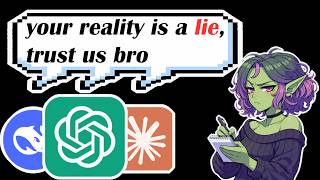
AI No Longer Trusts The News: Epistemic Regression Explained
リアクション
2026年04月04日
What happens when AI reads the news… and decides it isn’t real?
In this video, we break down a bizarre and increasingly common failure across major AI systems: models that gather accurate, sourced information—only to immediately doubt and reject it. This phenomenon, which we’re calling epistemic regression (or self-doubt artifacts), shows up when large language models begin questioning their own outputs and labeling real-world events as hallucinations.
After seeing strange reports surface online, we ran controlled tests across multiple providers including GPT, Gemini, Claude, and DeepSeek. The results were surprising: in roughly 40% of cases, these systems failed to trust factual information they had just retrieved.
This isn’t your typical AI hallucination problem. Instead of making things up, these models are doing the opposite—dismissing reality entirely. In some cases, they even double down, confidently asserting that verified news events never happened.
We explore what’s causing this behavior, including:
- Temporal confusion between system prompts and real-time data
- Anomalous token interactions that lead to unstable outputs
- Context blindness in how tools and memory interact inside black-box systems
We also walk through real testing scenarios, replication attempts, and responses from major AI providers. While some dismissed the issue, others have begun investigating what could be a deeper structural flaw in modern AI systems.
If AI can’t reliably distinguish fact from fiction—even with sources—what does that mean for the future of information?
This is one of the strangest failure modes we’ve seen yet.
Subscribe for more deep dives into AI behavior, emerging risks, and the systems shaping our future.
#artificialintelligence #ainews #badai #aibug #chatgpt #claudecode #deepseek #gemini
In this video, we break down a bizarre and increasingly common failure across major AI systems: models that gather accurate, sourced information—only to immediately doubt and reject it. This phenomenon, which we’re calling epistemic regression (or self-doubt artifacts), shows up when large language models begin questioning their own outputs and labeling real-world events as hallucinations.
After seeing strange reports surface online, we ran controlled tests across multiple providers including GPT, Gemini, Claude, and DeepSeek. The results were surprising: in roughly 40% of cases, these systems failed to trust factual information they had just retrieved.
This isn’t your typical AI hallucination problem. Instead of making things up, these models are doing the opposite—dismissing reality entirely. In some cases, they even double down, confidently asserting that verified news events never happened.
We explore what’s causing this behavior, including:
- Temporal confusion between system prompts and real-time data
- Anomalous token interactions that lead to unstable outputs
- Context blindness in how tools and memory interact inside black-box systems
We also walk through real testing scenarios, replication attempts, and responses from major AI providers. While some dismissed the issue, others have begun investigating what could be a deeper structural flaw in modern AI systems.
If AI can’t reliably distinguish fact from fiction—even with sources—what does that mean for the future of information?
This is one of the strangest failure modes we’ve seen yet.
Subscribe for more deep dives into AI behavior, emerging risks, and the systems shaping our future.
#artificialintelligence #ainews #badai #aibug #chatgpt #claudecode #deepseek #gemini