ChatGPT in Agriculture Lesson 7
リアクション
2026年04月06日
Welcome to Lesson 7 of the course How to Use ChatGPT in Agriculture. In this lesson, we explore 5 practical prompts for research, advisory, and education and show how ChatGPT for agriculture can support people beyond the farm gate. This lesson is especially useful for researchers, agricultural advisors, consultants, educators, students, agronomists, and agri-tech teams who need to explain technical topics clearly, summarise information quickly, and structure ideas into more useful outputs.
You will see how AI in agriculture can help with tasks such as creating a literature summary, explaining concepts like NDVI in plain English, designing a short training outline for new workers, comparing drone imaging, smartphone imaging, and satellite imagery, and organising field observations into a clearer structure. Rather than treating ChatGPT as a source of final scientific truth, this lesson shows how it can work as a practical assistant for agricultural research, advisory services, agricultural education, and technical communication.
In this lesson, you will learn how to use prompts such as:
summarising recent research about AI in crop monitoring
explaining satellite imagery and NDVI to farmers in simple language
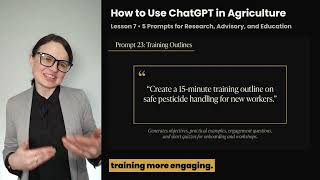
creating a 15-minute training outline on safe pesticide handling
comparing imaging technologies for routine crop monitoring
structuring messy field notes into a simple comparison table and identifying the next questions to ask
This makes the lesson highly relevant for anyone interested in:
digital agriculture, precision agriculture, crop monitoring, agricultural training, agricultural education, agronomy communication, farm advisory, agri-tech workflows, agricultural AI tools, machine learning in agriculture, remote sensing in agriculture, farm data interpretation, and research support with AI.
A key message of Lesson 7 is that ChatGPT in agriculture works best when it acts as a translator, organiser, and teaching assistant. It can help turn complex agricultural language into practical explanations. It can help advisors compare technologies more clearly. It can help educators create structured learning materials. It can help researchers organise observations and identify follow-up questions faster. But it should not replace proper scientific review, expert validation, or careful interpretation of research evidence.
This lesson is ideal if you want to learn:
how to use ChatGPT for agricultural research
how to use ChatGPT for farm advisory and extension work
how to use ChatGPT for agricultural education and training
how to explain NDVI, crop monitoring, phenotyping, digital twins, carbon metrics, and machine learning in simpler language
how to compare agricultural technologies with better structure
how to organise field data, plot observations, and experimental notes more effectively with AI support
If you are a farmer, agronomist, student, lecturer, consultant, researcher, extension officer, or agri-tech founder, this lesson will give you practical examples of how ChatGPT can improve communication, summarisation, explanation, and training in agriculture.
This course, How to Use ChatGPT in Agriculture, is designed for beginners who want realistic and practical ways to apply AI tools in the agricultural sector. Lesson 7 focuses on one of the most valuable uses of AI: helping people move from complexity to clarity.
Topics covered in this lesson include:
AI in crop monitoring, NDVI explanation, satellite imagery for farmers, literature review support, agricultural training materials, pesticide safety training, drone vs smartphone vs satellite imagery, farm advisory prompts, agricultural education prompts, research prompts for agriculture, and field data structuring.
Watch this lesson to learn how to make ChatGPT for agriculture more useful in real professional situations where explanation, comparison, and structured thinking matter.
You will see how AI in agriculture can help with tasks such as creating a literature summary, explaining concepts like NDVI in plain English, designing a short training outline for new workers, comparing drone imaging, smartphone imaging, and satellite imagery, and organising field observations into a clearer structure. Rather than treating ChatGPT as a source of final scientific truth, this lesson shows how it can work as a practical assistant for agricultural research, advisory services, agricultural education, and technical communication.
In this lesson, you will learn how to use prompts such as:
summarising recent research about AI in crop monitoring
explaining satellite imagery and NDVI to farmers in simple language
creating a 15-minute training outline on safe pesticide handling
comparing imaging technologies for routine crop monitoring
structuring messy field notes into a simple comparison table and identifying the next questions to ask
This makes the lesson highly relevant for anyone interested in:
digital agriculture, precision agriculture, crop monitoring, agricultural training, agricultural education, agronomy communication, farm advisory, agri-tech workflows, agricultural AI tools, machine learning in agriculture, remote sensing in agriculture, farm data interpretation, and research support with AI.
A key message of Lesson 7 is that ChatGPT in agriculture works best when it acts as a translator, organiser, and teaching assistant. It can help turn complex agricultural language into practical explanations. It can help advisors compare technologies more clearly. It can help educators create structured learning materials. It can help researchers organise observations and identify follow-up questions faster. But it should not replace proper scientific review, expert validation, or careful interpretation of research evidence.
This lesson is ideal if you want to learn:
how to use ChatGPT for agricultural research
how to use ChatGPT for farm advisory and extension work
how to use ChatGPT for agricultural education and training
how to explain NDVI, crop monitoring, phenotyping, digital twins, carbon metrics, and machine learning in simpler language
how to compare agricultural technologies with better structure
how to organise field data, plot observations, and experimental notes more effectively with AI support
If you are a farmer, agronomist, student, lecturer, consultant, researcher, extension officer, or agri-tech founder, this lesson will give you practical examples of how ChatGPT can improve communication, summarisation, explanation, and training in agriculture.
This course, How to Use ChatGPT in Agriculture, is designed for beginners who want realistic and practical ways to apply AI tools in the agricultural sector. Lesson 7 focuses on one of the most valuable uses of AI: helping people move from complexity to clarity.
Topics covered in this lesson include:
AI in crop monitoring, NDVI explanation, satellite imagery for farmers, literature review support, agricultural training materials, pesticide safety training, drone vs smartphone vs satellite imagery, farm advisory prompts, agricultural education prompts, research prompts for agriculture, and field data structuring.
Watch this lesson to learn how to make ChatGPT for agriculture more useful in real professional situations where explanation, comparison, and structured thinking matter.