EP81 PROF MARCI SHORE ON UKRAINE, RUSSIA'S RATIONALE FOR THE WAR AND WHETHER TRUMP IS A FASCIST
リアクション
2026年06月08日
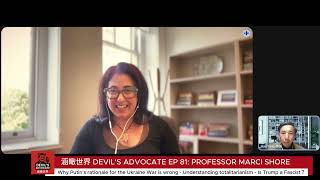
In this episode of Devil’s Advocate, I talk with historian and public intellectual Marci Shore.
Drawing on her work on totalitarianism, Eastern Europe, and Ukraine, Professor Shore discusses how ordinary people navigate life under oppressive systems, the moral dilemmas faced by individuals living under dictatorship, and what remains of totalitarianism long after regimes formally collapse. We examine the similarities and differences between 20th century fascism and its current form , the nature of fascism, and the role that truth, propaganda, and political lies play in authoritarian societies.
A major focus of the conversation is the war in Ukraine. We explore competing interpretations of the conflict, including realist arguments emphasizing NATO expansion, Russian security concerns, and great-power competition, alongside perspectives that stress imperialism, ideology, national identity, and moral responsibility. Professor Shore explains why she believes the lived experience of Ukrainians matters and discusses whether moral clarity is possible during war and oppression, how individuals should think about responsibility when survival requires compromise, and whether contemporary observers are too quick to judge those who lived under past dictatorships.
We examine democratic backsliding and contemporary politics, including the usefulness and limits of historical analogies, warning signs of democratic erosion, and ongoing debates about whether concepts such as fascism can help us understand political developments in the United States.
Marci Shore is a Professor at the Munk School of Global Affairs and Public Policy at the University of Toronto. Shore received her BA from Stanford University, her MA from University of Toronto, and her Ph.D from Stanford University. After completing her doctorate, she was a postdoctoral fellow at the Harriman Institute of Columbia University and subsequently assistant professor of history at Indiana University from 2002 to 2006.
Her research focuses on the intellectual history of twentieth and twenty-first century Central and Eastern Europe. Since 2004 she has been a regular visiting fellow at the Institut für die Wissenschaften vom Menschen in Vienna. She is the translator of Michał Głowiński's The Black Seasons and the author of The Taste of Ashes: The Afterlife of Totalitarianism in Eastern Europe. Her first book, Caviar and Ashes: A Warsaw Generation's Life and Death in Marxism, 1918-1968, won eight awards (and was shortlisted for several more) including the 2006 National Jewish Book Award in Eastern European Studies, the 2007 Oskar Halecki Polish/East Central European History Award, and the 2007 co-winner of the American Association for the Advancement of Slavic Studies/Orbis Books Prize for Polish Studies.
A new edition of her third book, The Ukrainian Night: An Intimate History of Revolution, was published in March 2024. Her articles and essays have appeared in The New Yorker, Foreign Policy, Eurozine, The Atlantic, The Yale Review, The New York Review of Books, The Times Literary Supplement, The New York Times, and The Wall Street Journal. In 2018 she received a Guggenheim Fellowship for the book project about phenomenology in East-Central Europe tentatively titled In Pursuit of Certainty Lost: Central European Encounters on the Way to Truth.
https://x.com/marci_shore
Drawing on her work on totalitarianism, Eastern Europe, and Ukraine, Professor Shore discusses how ordinary people navigate life under oppressive systems, the moral dilemmas faced by individuals living under dictatorship, and what remains of totalitarianism long after regimes formally collapse. We examine the similarities and differences between 20th century fascism and its current form , the nature of fascism, and the role that truth, propaganda, and political lies play in authoritarian societies.
A major focus of the conversation is the war in Ukraine. We explore competing interpretations of the conflict, including realist arguments emphasizing NATO expansion, Russian security concerns, and great-power competition, alongside perspectives that stress imperialism, ideology, national identity, and moral responsibility. Professor Shore explains why she believes the lived experience of Ukrainians matters and discusses whether moral clarity is possible during war and oppression, how individuals should think about responsibility when survival requires compromise, and whether contemporary observers are too quick to judge those who lived under past dictatorships.
We examine democratic backsliding and contemporary politics, including the usefulness and limits of historical analogies, warning signs of democratic erosion, and ongoing debates about whether concepts such as fascism can help us understand political developments in the United States.
Marci Shore is a Professor at the Munk School of Global Affairs and Public Policy at the University of Toronto. Shore received her BA from Stanford University, her MA from University of Toronto, and her Ph.D from Stanford University. After completing her doctorate, she was a postdoctoral fellow at the Harriman Institute of Columbia University and subsequently assistant professor of history at Indiana University from 2002 to 2006.
Her research focuses on the intellectual history of twentieth and twenty-first century Central and Eastern Europe. Since 2004 she has been a regular visiting fellow at the Institut für die Wissenschaften vom Menschen in Vienna. She is the translator of Michał Głowiński's The Black Seasons and the author of The Taste of Ashes: The Afterlife of Totalitarianism in Eastern Europe. Her first book, Caviar and Ashes: A Warsaw Generation's Life and Death in Marxism, 1918-1968, won eight awards (and was shortlisted for several more) including the 2006 National Jewish Book Award in Eastern European Studies, the 2007 Oskar Halecki Polish/East Central European History Award, and the 2007 co-winner of the American Association for the Advancement of Slavic Studies/Orbis Books Prize for Polish Studies.
A new edition of her third book, The Ukrainian Night: An Intimate History of Revolution, was published in March 2024. Her articles and essays have appeared in The New Yorker, Foreign Policy, Eurozine, The Atlantic, The Yale Review, The New York Review of Books, The Times Literary Supplement, The New York Times, and The Wall Street Journal. In 2018 she received a Guggenheim Fellowship for the book project about phenomenology in East-Central Europe tentatively titled In Pursuit of Certainty Lost: Central European Encounters on the Way to Truth.
https://x.com/marci_shore