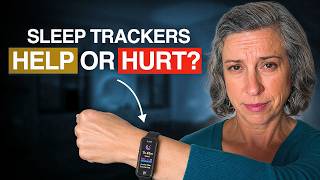
Is Your Sleep Tracker Making Your Sleep Worse?
リアクション
2026年05月06日
If you want to know what's actually driving your sleep issues, book a free consultation with me here: https://p.bttr.to/3VJwvDs
If you're wearing a sleep tracker and still not sleeping well, this episode will change how you think about it.
Most people with chronic sleep issues assume that tracking their sleep is a smart first step. But depending on where you are in your sleep journey, your tracker could be making things worse. In this episode I'm breaking down how accurate sleep trackers actually are for measuring sleep stages like deep sleep and REM sleep, why tracking can increase sleep anxiety and orthosomnia, and when sleep tracking is actually useful. I cover the Oura Ring, Whoop, Apple Watch, Fitbit, and Garmin and what the latest independent research says about their accuracy compared to clinical polysomnography.
If you've been wondering why your sleep score keeps changing even when you feel like you slept the same, or whether your deep sleep and REM numbers are actually accurate, or whether wearing a tracker is helping or hurting your sleep — this episode answers all of that.
Most people think that tracking their sleep will help them fix it. But for a lot of people who are already anxious about sleep, it just gives them one more thing to worry about at 3am.
How accurate sleep trackers really are for sleep staging, deep sleep, and REM — the research will surprise you
Why all six devices tested misclassify wake, deep sleep, and REM as light sleep
What trackers are actually reliable for — and it's not what most people focus on
The one question to ask yourself to know whether you should be tracking right now
Why how you feel when you wake up matters more than any sleep score
When tracking becomes a useful tool instead of a source of anxiety
If you're tracking your sleep and still not sleeping better, a wearable can't tell you why. Understanding the root cause of your sleep issues is where real change begins.
If you want to know what's actually driving your sleep issues, book a free consultation with me here: https://p.bttr.to/3VJwvDs
Sleep tracker accuracy, Oura ring sleep tracking, whoop sleep tracker, apple watch sleep tracking, does sleep tracking help, sleep anxiety, orthosomnia, deep sleep tracker accuracy, REM sleep tracker, best sleep tracker, sleep score, how to sleep better naturally, chronic sleep issues, functional sleep coaching, sleep detective
If you've been searching for whether sleep trackers are actually accurate, the answer is more complicated than most people realize. Independent research comparing wearables to clinical sleep studies shows that sleep staging — including deep sleep and REM detection — is where every device struggles most. Even the best performers only reach moderate accuracy. If you're not sleeping well and you're checking your sleep score every morning, you may be getting data that isn't reliable and adding stress that makes sleep harder.
For people dealing with chronic sleep issues, the question isn't just which sleep tracker is most accurate — it's whether tracking sleep is helping or hurting. Sleep anxiety and orthosomnia are real, and a tracker can make both worse. If you've tried everything to fix your sleep and you're still not getting answers, the problem usually isn't your sleep habits — it's something going on inside your body that no wearable can detect.
I'm Martha Lewis, sleep consultant and functional health coach. I talk about imbalances in the body such as gut health, hormone balance, liver function and more that affect sleep. I also help with mindset, anxiety about sleep and stress in general to address the mental component of not sleeping. If you've tried everything and you still can't sleep, this channel will tell you why! Find out more about me ➡︎ Get 7+ hours of uninterrupted sleep better permanently and naturally with functional lab testing | Get Started Today
=============================
By viewing this video you understand that this video is for educational purposes only. It is not intended to substitute for professional medical advice and should not be relied on as health or personal advice. Always seek the guidance of your doctor with any questions you may have regarding your health or medical condition.
#sleepdetective #MarthaLewis #insomnia
If you're wearing a sleep tracker and still not sleeping well, this episode will change how you think about it.
Most people with chronic sleep issues assume that tracking their sleep is a smart first step. But depending on where you are in your sleep journey, your tracker could be making things worse. In this episode I'm breaking down how accurate sleep trackers actually are for measuring sleep stages like deep sleep and REM sleep, why tracking can increase sleep anxiety and orthosomnia, and when sleep tracking is actually useful. I cover the Oura Ring, Whoop, Apple Watch, Fitbit, and Garmin and what the latest independent research says about their accuracy compared to clinical polysomnography.
If you've been wondering why your sleep score keeps changing even when you feel like you slept the same, or whether your deep sleep and REM numbers are actually accurate, or whether wearing a tracker is helping or hurting your sleep — this episode answers all of that.
Most people think that tracking their sleep will help them fix it. But for a lot of people who are already anxious about sleep, it just gives them one more thing to worry about at 3am.
How accurate sleep trackers really are for sleep staging, deep sleep, and REM — the research will surprise you
Why all six devices tested misclassify wake, deep sleep, and REM as light sleep
What trackers are actually reliable for — and it's not what most people focus on
The one question to ask yourself to know whether you should be tracking right now
Why how you feel when you wake up matters more than any sleep score
When tracking becomes a useful tool instead of a source of anxiety
If you're tracking your sleep and still not sleeping better, a wearable can't tell you why. Understanding the root cause of your sleep issues is where real change begins.
If you want to know what's actually driving your sleep issues, book a free consultation with me here: https://p.bttr.to/3VJwvDs
Sleep tracker accuracy, Oura ring sleep tracking, whoop sleep tracker, apple watch sleep tracking, does sleep tracking help, sleep anxiety, orthosomnia, deep sleep tracker accuracy, REM sleep tracker, best sleep tracker, sleep score, how to sleep better naturally, chronic sleep issues, functional sleep coaching, sleep detective
If you've been searching for whether sleep trackers are actually accurate, the answer is more complicated than most people realize. Independent research comparing wearables to clinical sleep studies shows that sleep staging — including deep sleep and REM detection — is where every device struggles most. Even the best performers only reach moderate accuracy. If you're not sleeping well and you're checking your sleep score every morning, you may be getting data that isn't reliable and adding stress that makes sleep harder.
For people dealing with chronic sleep issues, the question isn't just which sleep tracker is most accurate — it's whether tracking sleep is helping or hurting. Sleep anxiety and orthosomnia are real, and a tracker can make both worse. If you've tried everything to fix your sleep and you're still not getting answers, the problem usually isn't your sleep habits — it's something going on inside your body that no wearable can detect.
I'm Martha Lewis, sleep consultant and functional health coach. I talk about imbalances in the body such as gut health, hormone balance, liver function and more that affect sleep. I also help with mindset, anxiety about sleep and stress in general to address the mental component of not sleeping. If you've tried everything and you still can't sleep, this channel will tell you why! Find out more about me ➡︎ Get 7+ hours of uninterrupted sleep better permanently and naturally with functional lab testing | Get Started Today
=============================
By viewing this video you understand that this video is for educational purposes only. It is not intended to substitute for professional medical advice and should not be relied on as health or personal advice. Always seek the guidance of your doctor with any questions you may have regarding your health or medical condition.
#sleepdetective #MarthaLewis #insomnia